From Enquiry to Client: Building a Lead Nurture Funnel for Service Firms
A form gets submitted, the lead count ticks up by one, and then — quite often — nothing structured happens next. For a lot of UK service businesses, this is exactly where good marketing quietly goes to waste. The enquiry was hard-won. What happens in the days afterwards usually decides whether it becomes a client, or just a name nobody got round to calling back.
Marketing doesn't end at the form submission. Commercially, it ends at the signed agreement — and there's a whole process in between that most reporting ignores completely.
What a Lead Nurture Funnel Actually Is
A lead nurture funnel is the structured path a prospect travels after their first enquiry, through qualification and follow-up, to becoming a paying client. It's worth being precise about the stages, because businesses that blur them tend to treat every enquiry identically — a fast way to waste time on the wrong ones.
- Visitor — someone browsing your website, not yet identified.
- Enquiry — a form, call or message; contact has been made.
- Lead — an enquiry that's been logged and assigned to someone.
- Qualified lead — confirmed to need your service, within budget and area.
- Sales opportunity — actively being worked towards a proposal.
- Client — the agreement is signed.
Where Leads Quietly Go to Die
Enquiries rarely fail loudly. They fail through delay and drift: a form sits unanswered for two days, nobody clearly owns it, the reply is generic enough to have gone to anyone, and there's no next step booked in. Multiply that across a busy week and a meaningful share of hard-earned enquiries simply evaporate — not because the marketing failed, but because of what happened after it succeeded.
The Six Stages of a Service Business Funnel
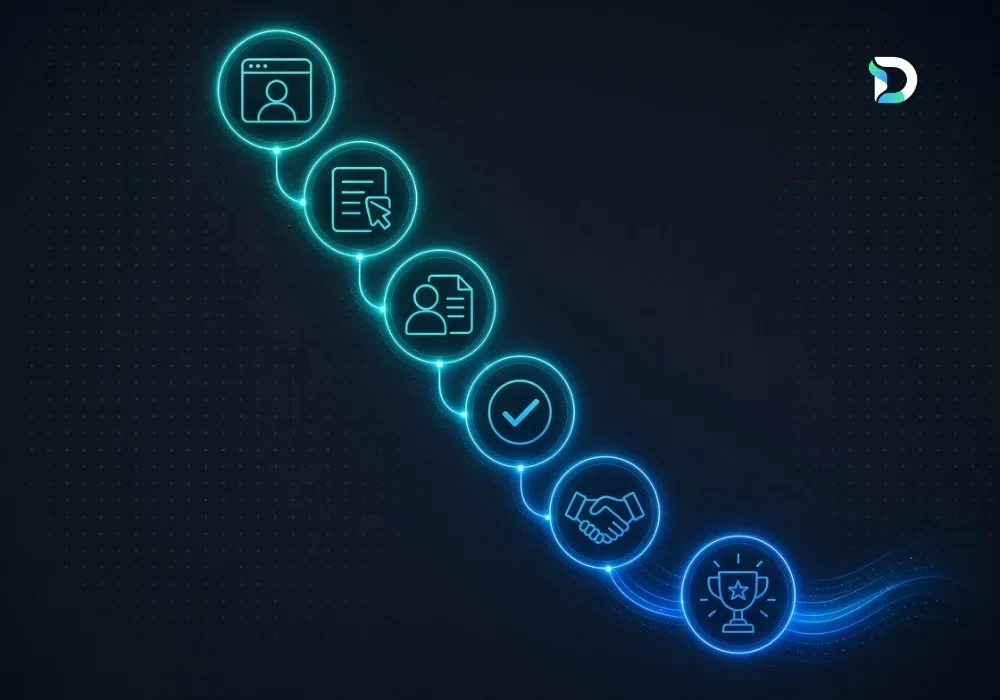
1. Generate
SEO, Google Ads, Meta Ads, local search and referrals bring people to your website or profile in the first place.
2. Capture
A form, phone call, email or consultation request turns an anonymous visitor into a named contact.
3. Qualify
Confirm the basics — service needed, location, scale, timeline and budget fit — before investing further time.
4. Nurture
Follow up with useful, specific information rather than a generic template. Case studies and direct answers to likely questions do more work here than a sales pitch.
5. Convert
Consultation, proposal, negotiation, agreement — the stage where a qualified lead becomes a commercial decision.
6. Retain
Onboarding and delivery shape whether this client refers you or comes back — a cheaper, higher-trust source of future leads than any ad campaign.
A Practical Follow-Up Workflow
A workable sequence doesn't need to be complicated: confirm receipt immediately, follow up personally within hours rather than days, qualify against clear criteria, carry out a proper needs assessment, move to consultation or proposal, follow up again, then record the outcome as won or lost — and note why, so the pattern becomes visible over time rather than repeating unnoticed.
Qualifying Leads for a UK Service Business
The criteria vary by industry, but the useful ones tend to be similar: what service is required, whether the property is within your service area, the size of the project, the estimated budget, the deadline and time pressure, whether you're speaking to the decision-maker, and whether the job matches what you actually do.
Take a fictional example: a commercial cleaning company receives a quote request for a one-off deep clean well outside its normal contract service area. Not worth ignoring — but not as high a priority as a contract request from within its main patch. Clear criteria are what let you tell the two apart quickly, instead of treating both the same.
Where Marketing Attribution Fits Into the Funnel
This ties directly back to how leads are counted in the first place. A customer might arrive through an SEO post, convert on a landing page after clicking a Google Ad, or call because they saw your Google Business Profile listing. A good funnel gives every channel its fair share of the credit, not just the last one touched. Lead attribution and lead nurturing aren't separate concerns — a process that measures qualification but ignores where the lead came from misses half the picture.
Why Tracking Enquiries Alone Isn't Enough
Enquiry volume is the easiest number to report and, on its own, one of the least useful. A campaign generating a hundred enquiries that convert poorly can be a worse investment than one generating thirty that convert well. The figures below are illustrative only, not real client data, but they show why each stage matters:
| Stage | Illustrative example |
|---|---|
| Enquiries | 100 |
| Qualified leads | 58 |
| Sales opportunities | 35 |
| Proposals sent | 24 |
| New clients | 12 |
| Revenue | Tracked per client, not per enquiry |
Building a Lead Nurture Dashboard
A useful dashboard for this kind of funnel typically covers three layers: where leads came from (organic, Google Ads, Meta Ads, Google Business Profile, referral, direct), where each lead currently sits (enquiry, qualified, working, proposal, won, lost), and the business metrics that tie the two together — lead-to-qualified rate, qualified-to-client rate, cost per qualified lead and revenue by source.
From Lead Generation to Revenue Attribution
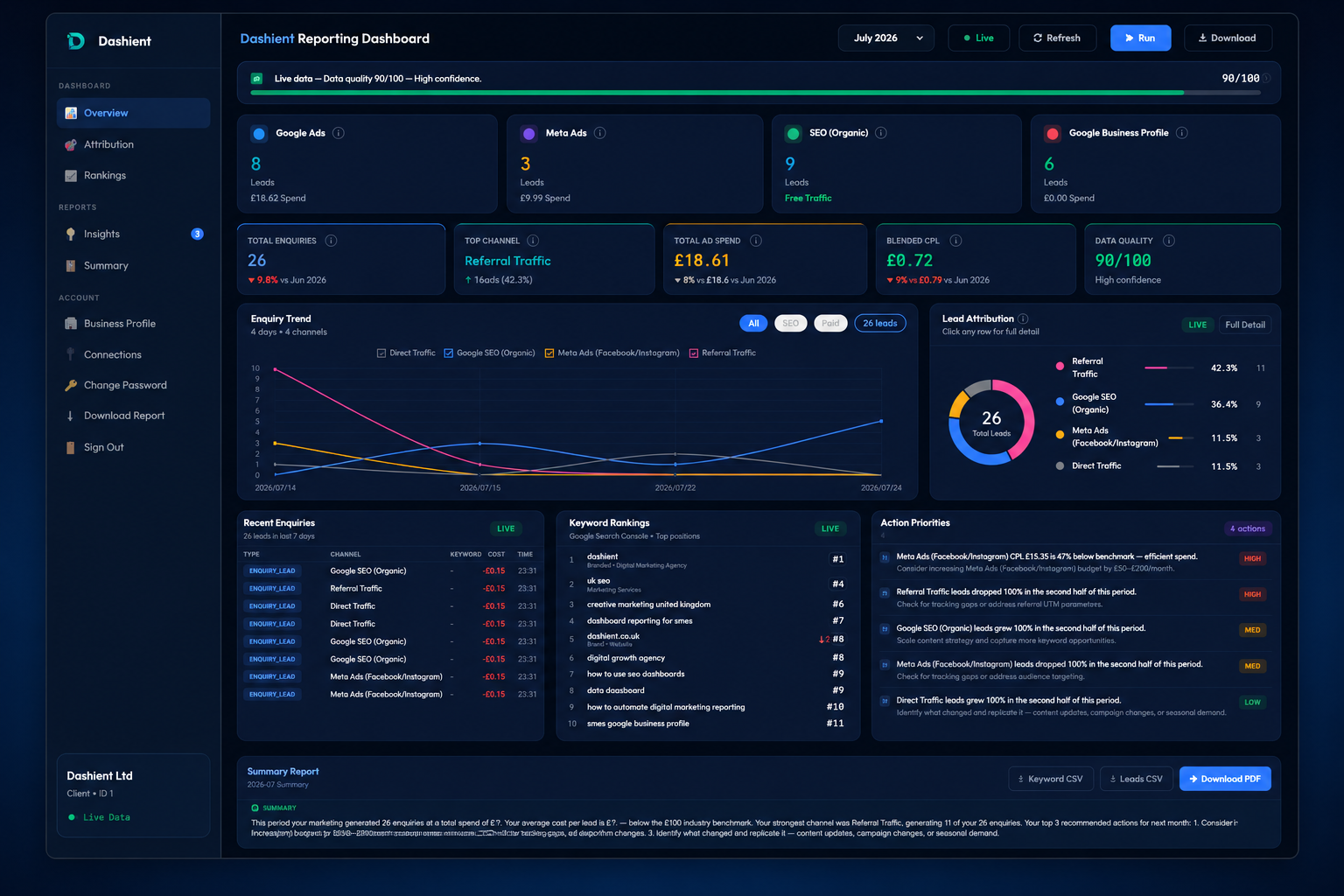
This is where a lot of UK service businesses hit a wall — not because they lack data, but because it's scattered across a CRM, an ads platform and an analytics tool that don't talk to each other. The Dashient Reporting Dashboard (DRD) is built to close that gap. It connects Google Ads, Meta Ads, GA4, Search Console and Google Business Profile into one connected view, and matches enquiries — forms, click-to-call taps and direction requests — back to the channel that actually produced them, using multi-touch attribution rather than crediting only the last click.
Paired with clear lead-stage tracking, that means you can finally see not just which channel generated an enquiry, but which channels tend to produce enquiries that actually become clients. It refreshes daily, calculates blended cost per enquiry across channels, and setup typically takes a couple of hours across two short calls. For the fuller picture of how the models work, see our guide to multi-source lead attribution.
Common Lead Nurture Mistakes
- Treating every enquiry as equally valuable regardless of fit.
- Slow or inconsistent follow-up, especially outside office hours.
- No clear ownership — enquiries sit in a shared inbox with nobody accountable.
- Sending the same generic reply to every lead.
- Tracking leads generated but never following through to clients won.
- Ignoring phone enquiries and offline conversions entirely.
- Giving all credit for a client to the final marketing touchpoint.
How SEO, Paid Ads and Lead Nurturing Work Together
Acquisition, qualification and follow-up aren't separate systems — they're one connected pipeline. SEO, Google Ads and Meta Ads and local search bring the traffic; the website or profile captures the enquiry; qualification and nurturing decide whether it becomes an opportunity; and the sales process turns that opportunity into revenue. Treat any one stage in isolation and you'll optimise a part of the funnel while the rest quietly leaks.
Frequently asked questions
Final Thoughts
Enquiry volume feels like progress, but it isn't the goal — clients and revenue are. A funnel that tracks qualification stages properly, follows up quickly and connects marketing sources to actual business outcomes will consistently outperform one that only counts form fills.
If you'd like to talk through which package fits your business, get in touch and book your free growth audit — we'll walk you through your options. You can also follow Dashient on Facebook and LinkedIn.