Final Checklist: Can You Actually Identify Your Best Lead Source?

Ask most UK service-business owners which channel brings in their best lead source, and you'll get a guess dressed up as an answer. "Probably Google Ads." "I think it's word of mouth." "Our website, maybe?" The truth is that most businesses are running their marketing on instinct, not evidence — and that gap is exactly where budget quietly leaks away.
This checklist is built to close that gap. Work through it honestly, and you'll know within minutes whether you can actually name your best lead source, or whether your reporting is guessing for you.
What Does "Best Lead Source" Actually Mean?
A lead source isn't just "where the click came from." It's the full path a buyer took before they picked up the phone or filled in a form. A real UK enquiry rarely happens in one step: someone sees a Meta ad, forgets about it, searches your service two days later, taps a Google Business Profile listing, then calls from their car.
Most standard marketing reporting tools give last-click credit to whichever channel happened to be there at the final moment — usually Google Business Profile or organic search — and give zero credit to the ad that actually started the journey. That's not your best lead source. That's just the last thing Google Ads or GA4 happened to see.
The Final Checklist: 8 Questions to Test Your Lead Tracking
Go through these one by one. If you can't confidently answer "yes" to most of them, you don't yet have a reliable view of your best lead source.
- Can you name, right now, which channel produced the most enquiries last month — not sessions, actual enquiries?
- Does your reporting combine Google Ads, Meta Ads, GA4, Search Console and Google Business Profile in one place, rather than five separate logins?
- Can you see click-to-call taps and direction requests, not just form submissions?
- Does your data update daily, or are you working from a PDF that's three weeks stale by the time you read it?
- Can you tell the difference between a channel that introduces buyers and one that simply gets the final click?
- Do you know your blended cost-per-enquiry across paid, organic and local — not just cost-per-click on ads?
- Would you notice this week if a channel's performance dropped, or only when the enquiries had already dried up?
- If your agency's report, GA4 and your ad platform gave you three different lead counts, would you know which one to trust?
Why Most Marketing Reporting Tools Get This Wrong
Plenty of SEO reporting software and analytics dashboards will show you traffic, rankings and sessions in tidy charts. What they don't do is connect that traffic back to an actual enquiry and credit the right channel for starting it. That's a different job — attribution, not just reporting — and it's the specific gap covered in our guide to Lead Attribution for UK SMEs.
Without proper attribution, SME budgets drift toward whichever channel is easiest to measure, not whichever channel actually works. Ads get cut because they "aren't converting," when in reality they were the first touch in a journey that organic search or GBP simply finished.
How the Dashient Reporting Dashboard (DRD) Solves This
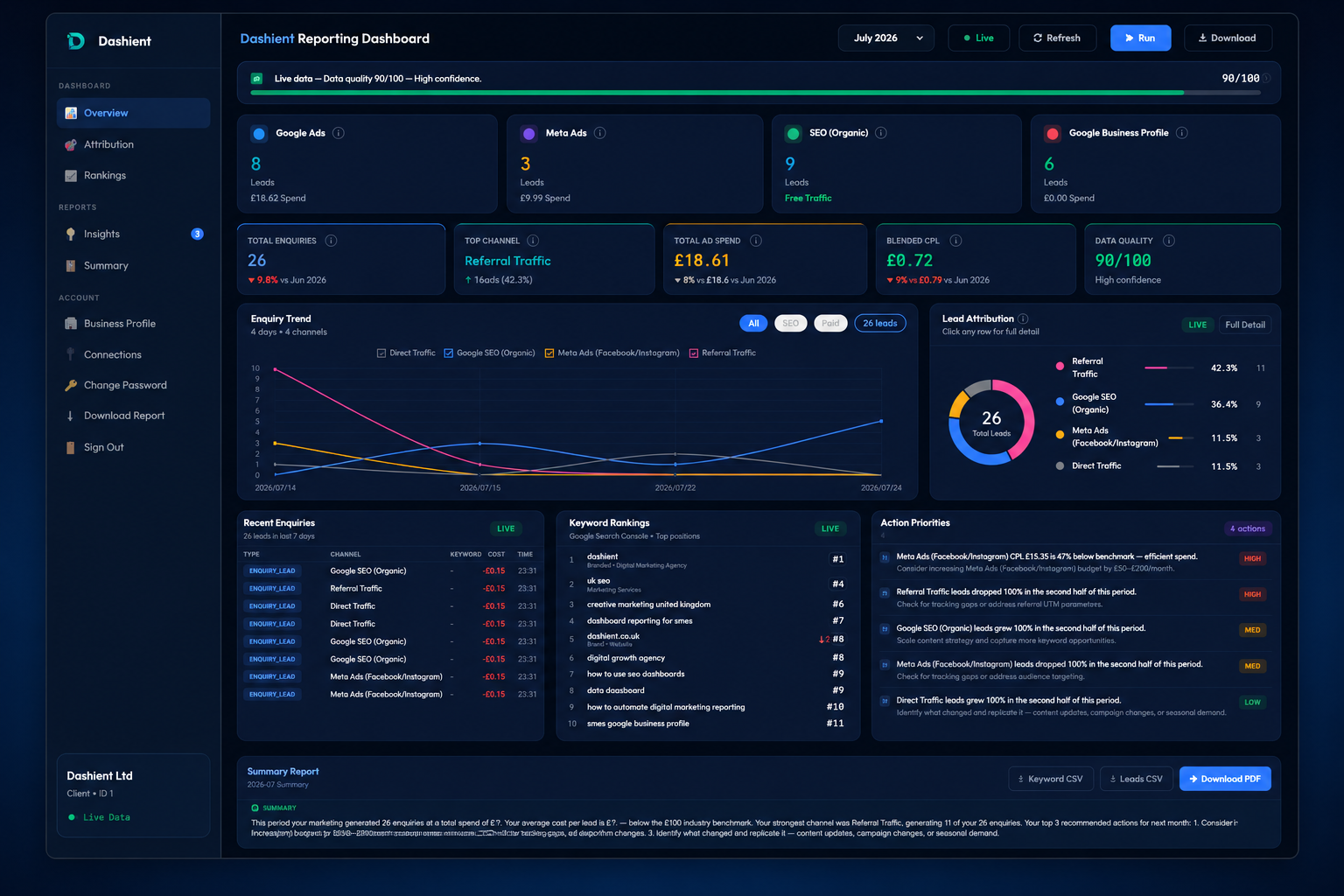
This is exactly the problem the Dashient Reporting Dashboard (DRD) was built to solve. DRD connects Google Ads, Meta Ads, GA4, Search Console and Google Business Profile through one Google login and one Meta login — setup typically takes 1–3 hours across two calls, not weeks of a data project.
Every enquiry — form submission, click-to-call tap or direction request — is matched back to its source and given weighted credit across the full path it took, not just the last click. Your dashboard refreshes daily, so you see which channel is genuinely your best lead source this week, not last month.
It's built to sit alongside real delivery, not replace it. See exactly how the process runs, from first login to your first attributed report, on our How It Works page.
Frequently asked questions
Final Thoughts
If you worked through the checklist above and found more gaps than confident "yesses," you're not alone — most UK service businesses are in the same position, because standard marketing reporting tools simply weren't built to answer this question. Finding your true best lead source takes proper multi-source attribution, not another chart of sessions and clicks.
Want to see exactly which channel is driving your enquiries? Get in touch and book your free growth audit — we'll walk through your data and show you what your real best lead source looks like. You can also follow Dashient on Facebook and LinkedIn.