U-Shaped Attribution: The Multi-Touch Model, Explained
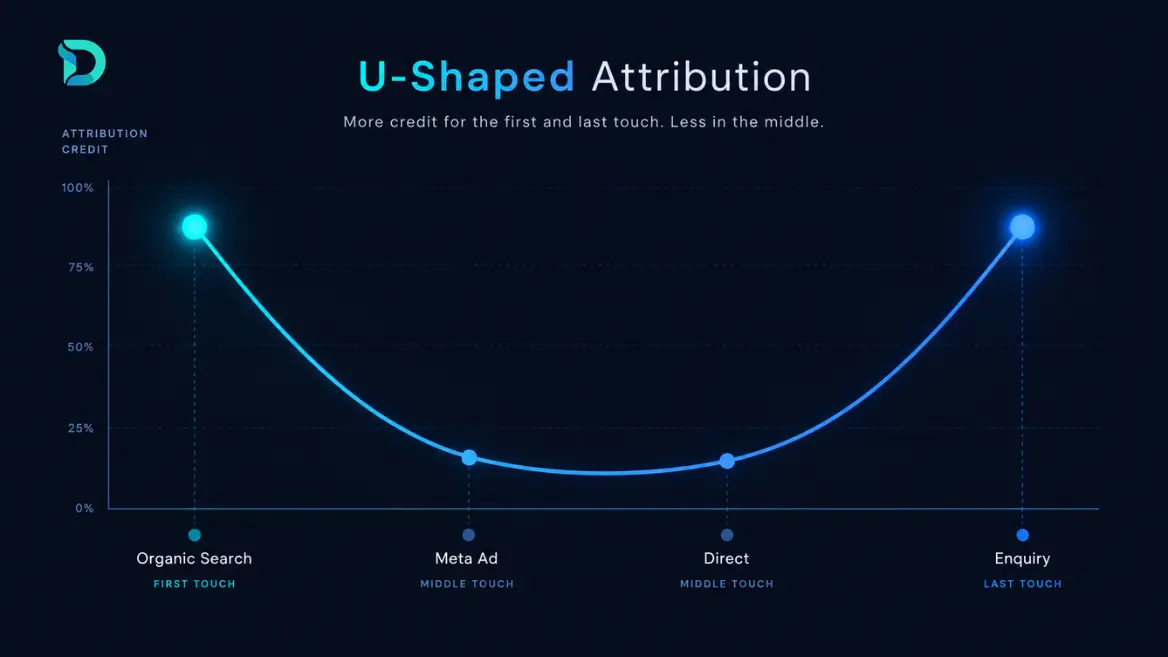
If you spend money on marketing, you've almost certainly been told which channel is "working" — and you've almost certainly been told wrong. The reason is a quiet, technical decision buried inside nearly every reporting tool: how it assigns credit for a lead. Most tools use last-click attribution, which gives 100% of the credit to whatever a customer touched right before they enquired. It's simple, it's the default, and it's misleading enough to make you cut the exact channels that are bringing you business.
U-shaped attribution is the fix. In this guide we'll explain what it is, why last-click is costing you money, how the model actually works, and how we built a real multi-touch U-shaped model into the Dashient Reporting Dashboard (DRD) — including how it differs from both the cheap dashboards and the expensive enterprise platforms.
What Is U-Shaped Attribution?
U-shaped attribution — also called position-based attribution — is a multi-touch model that splits the credit for a single lead across every step of that customer's journey, with the most credit going to the two moments that matter most: the first touch (how they discovered you) and the last touch (what finally converted them).
The standard weighting is:
- 40% to the first touchpoint
- 40% to the last touchpoint
- 20% shared evenly across everything in between
Plot those weights and they form a "U" — high at both ends, lower in the middle — which is where the name comes from. The logic is intuitive: the channel that first made someone aware of you, and the channel that finally closed them, both did real work. The touches in between helped, but they didn't start or finish the job.
Why Last-Click Attribution Is Quietly Costing You Money
Real customers almost never buy in one step. A typical UK enquiry looks like this:
- Someone finds your blog post through an organic Google search (SEO — first touch).
- A week later they see a retargeting ad on Instagram (Meta Ads — middle touch).
- They search your business name directly and tap your Google Business Profile (last touch).
- They call.
Under last-click attribution, Google Business Profile gets 100% of the credit. SEO — the channel that actually started the relationship — gets nothing. Meta gets nothing.
Now imagine you're reviewing your reports and deciding where to cut. Last-click tells you "SEO isn't producing leads," so you cut your content budget. Three months later your enquiries dry up, and you have no idea why — because you defunded the channel that was quietly feeding the top of every journey. That's the real cost of last-click: it doesn't just misreport, it drives bad decisions.
Single-Touch vs Multi-Touch
There are really only two families of attribution:
- Single-touch gives all the credit to one touchpoint. Last-click and first-click are both single-touch. Simple, but blind to the journey.
- Multi-touch spreads credit across the whole path. U-shaped, linear, and time-decay models are all multi-touch.
Most budget reporting tools and most agency dashboards are single-touch (last-click), because it's easy to calculate and it makes for a tidy chart. Multi-touch is harder — it requires actually tracking a visitor's full journey across multiple visits — which is exactly why so few tools aimed at small businesses offer it.
How Dashient's U-Shaped Model Works
We didn't want to slap a "U-shaped" label on last-click data (which, quietly, some tools do). We built the real thing. Inside the DRD it works in four steps:
1. First-party journey tracking. A lightweight, privacy-friendly tracker records each visit's channel — organic search, referral, paid, direct, social — in a first-party cookie on your own site. Nothing leaves your domain, and it needs no invasive third-party permissions.
2. U-shaped position weighting. When a visitor becomes a lead, we look at their full journey and apply the 40 / 20 / 40 split across their touchpoints.
3. Exponential time decay. On top of the position weighting, we weight recent touches slightly more than older ones, using a seven-day half-life. A touch from yesterday counts for more than one from three weeks ago, because recency signals intent. This blend of position weighting and time decay is what we call the Dashient Hybrid model.
4. Genuine-leads only. This is the part nobody else does. Before any attribution runs, the DRD filters out spam, guest-post pitches, sales solicitations and test submissions, so your attribution is calculated on real prospective customers only — not the junk that clogs most contact forms. Attribution built on polluted lead data is worse than no attribution at all.
Each genuine lead is normalised to a single unit of credit, then credit is summed across every channel. The result is an honest picture of which channels start your customer journeys and which ones close them.
A Worked Example
Say one genuine lead took this journey: Organic Search → Meta Ad → Direct.
| Channel | Last-click credit | U-shaped credit |
|---|---|---|
| Organic Search (first) | 0% | 40% |
| Meta Ad (middle) | 0% | 20% |
| Direct (last) | 100% | 40% |
Under last-click, you'd conclude "Direct is my best channel" and never invest in the organic content that actually created the lead. Under U-shaped, you can see that organic search did 40% of the work — and you'd keep funding it.
Why This Matters More for UK SMEs
Enterprise brands can absorb wasted ad spend. A local service business can't. When every pound has to work, knowing which channel starts versus closes your enquiries is the difference between compounding growth and quietly bleeding budget into the wrong place. U-shaped attribution turns "I think Google Ads is working" into "Google Ads starts 40% of my journeys, and my Google Business Profile closes them" — a decision you can actually act on.
How Dashient Compares
Multi-touch attribution has existed for years — but it's been stuck at the two extremes of the market: too basic in cheap tools, and locked behind enterprise pricing everywhere else. Here's an honest look at where the DRD sits:
| Budget reporting tools | Typical agency dashboard | Enterprise attribution platforms | Dashient DRD | |
|---|---|---|---|---|
| Attribution model | Last-click | Last-click / platform-reported | Multi-touch | Multi-touch U-shaped + time decay |
| Spam / junk filtering | No | No | Rarely | Yes — genuine-lead classification |
| Setup | Self-serve, basic | Agency-managed | Complex, often needs a data team | First-party snippet, no invasive permissions |
| Typical price | Low | Bundled into retainer | High (enterprise contracts) | SME-friendly |
| Built for | Anyone | Agencies | Large enterprises | UK service businesses |
The gap we set out to close is the middle: real multi-touch attribution, at a price and a setup that a UK SME can actually use — with genuine-lead filtering built in, so the numbers reflect real customers and nothing else.
An Honest Caveat
Attribution modelling earns its keep when you have real volume across multiple channels. If you're getting a handful of enquiries a month through a single channel, any model — U-shaped included — is directional rather than definitive, and we'll tell you that plainly inside the dashboard rather than dress up thin data as precision. As your enquiries grow, the model gets sharper, and it starts answering the question every marketing budget hinges on: which channels actually bring me customers?
Frequently asked questions
See It in Your Own Data
The fastest way to understand your customer journeys is to watch them build up over time. The DRD unifies your Google Ads, Meta, GA4, Search Console and Google Business Profile, filters out the spam, and applies real U-shaped attribution to your genuine enquiries — in plain English, updated daily.
Start a 30-day free trial of the Dashient Reporting Dashboard and see which channels are really starting and closing your leads.
Related reading: Lead Attribution 101: How to Track Every Enquiry.