Self-Service BI vs Embedded Analytics vs DaaS: What's the Difference?
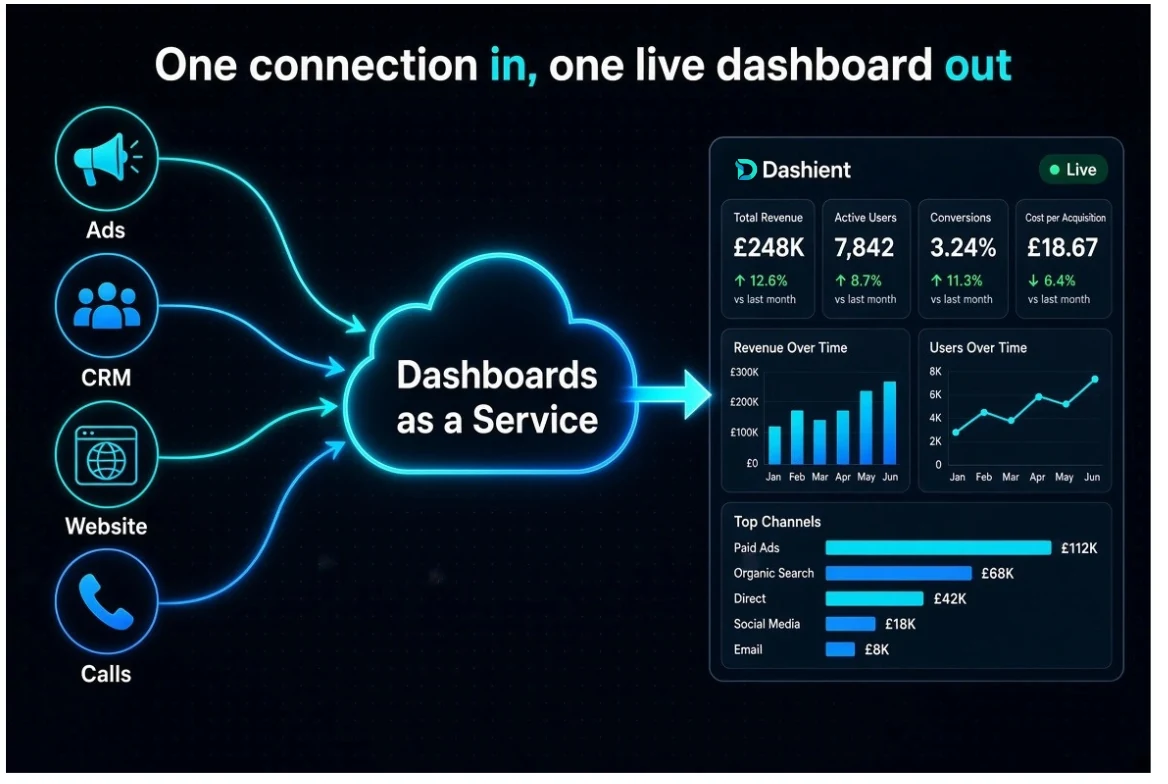
Self-service BI is software you use to build your own reports from data you already have. Embedded analytics is a dashboard built into another product you already use, so you never leave it. Dashboards as a service (DaaS) is different from both: a provider connects your data sources for you, builds and maintains the dashboard, and hands you a live, ready-made report you never have to configure yourself. It's the fastest route to accurate, always-on reporting for teams that don't have an in-house analyst.
When you're solving reporting and analysis at your business, these three similar-sounding options come up: self-service BI, embedded analytics, and DaaS analytics (dashboards as a service). All three promise "one place to look at your numbers," but they're designed to solve entirely different problems. Pick the wrong one and you end up with a purchase that's either too complex to run without an analyst, or too rigid to answer your actual questions. Here's how they compare.
What Is Self-Service BI?
Self-service business intelligence (BI) tools — think Power BI, Tableau, or Looker Studio — let non-technical users build their own charts and reports without writing code. You connect a data source, drag fields onto a canvas, and the tool generates a visual.
Where it works well:
- You have someone in-house who understands data modelling and can maintain the dashboards.
- Your reporting needs change often and you want full control over every metric.
- You're comfortable spending time on data cleaning, joins, and connector maintenance.
Where it falls short: self-service BI still requires setup. Someone has to connect each platform, define the metrics correctly, and fix the dashboard every time an API changes or a new channel is added. For a lean marketing team, that ongoing maintenance is often the real cost — not the software licence.
What Is Embedded Analytics?
Embedded analytics is a dashboard or reporting module built directly into another piece of software — for example, the "analytics" tab inside your CRM or ad platform. You don't install anything separate; the reporting simply lives inside the tool you already use.
Where it works well:
- You only need to see performance for that one platform (e.g. ad spend inside your ad manager).
- You want reporting with zero setup, built by the software vendor.
Where it falls short: embedded analytics is built to stay inside its own silo. It can tell you how well one channel did, but it can't compare your website, your advertising, your CRM and your calls side by side — because it was never designed to take in data from outside its own system. Ask it "which channel is driving my sales?" and it simply can't answer.
What Is Dashboards as a Service (DaaS)?
This is where dashboards as a service (DaaS analytics) comes in. Instead of building your own reports (self-service BI) or being limited to one platform's built-in view (embedded analytics), dashboards as a service means a provider does the technical work for you — connecting your data sources, structuring the metrics correctly, and delivering a live, maintained dashboard as an ongoing service.
In short: dashboard as a service, explained simply — you get the outcome of a custom BI build (one unified, accurate view across all your channels) without hiring an analyst, learning a BI tool, or maintaining connectors yourself. It's reporting delivered as a managed product, not a DIY tool.
A good way to remember the difference:
- Self-service BI = you build it, you maintain it.
- Embedded analytics = the vendor built it, but only for their own platform.
- Dashboards as a service = a provider builds and maintains a cross-platform dashboard for you.
Self-Service BI vs Embedded Analytics vs Dashboards as a Service: Side by Side
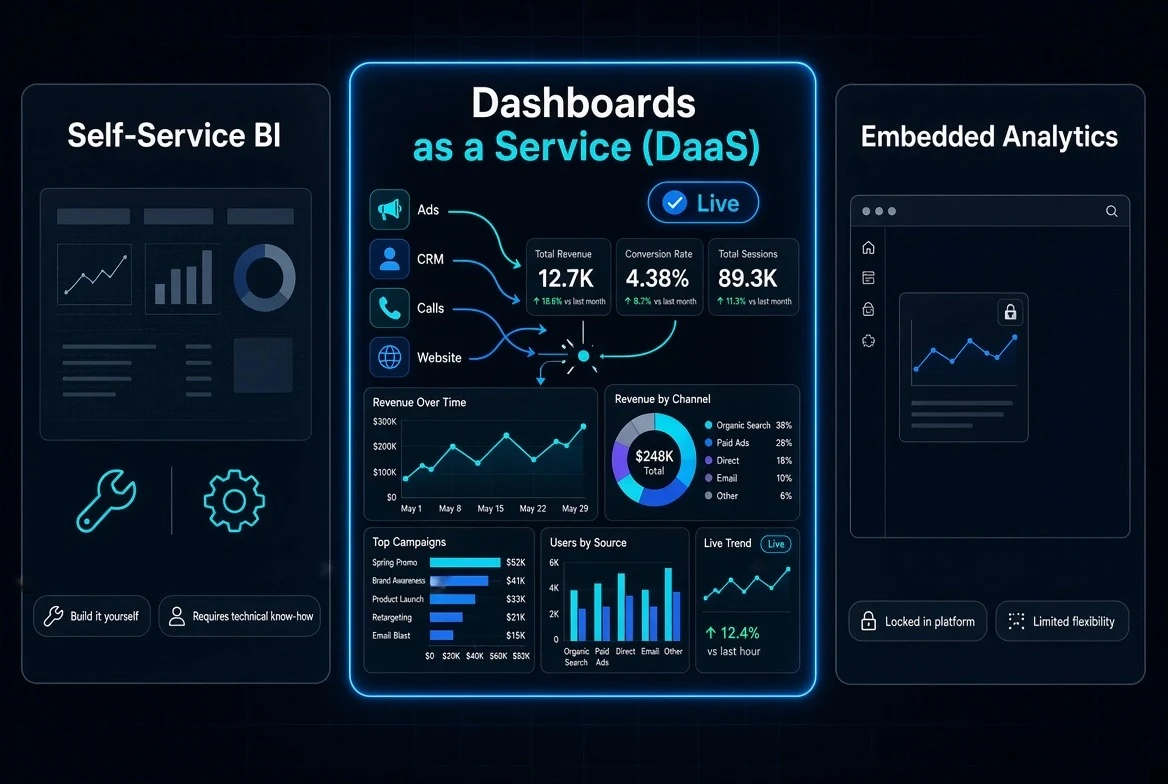
| Factor | Self-Service BI | Embedded Analytics | Dashboards as a Service |
|---|---|---|---|
| Setup effort | High — you build it | None — built in | Low — provider builds it |
| Cross-platform view | Possible, manual work | No — single platform only | Yes, by design |
| Ongoing maintenance | You / your team | Vendor (limited scope) | The DaaS provider |
| Skills needed | BI / data skills helpful | None | None |
| Best for | In-house data teams | Single-tool monitoring | Lean marketing teams needing one live view |
How the Dashient Reporting Dashboard Solves This
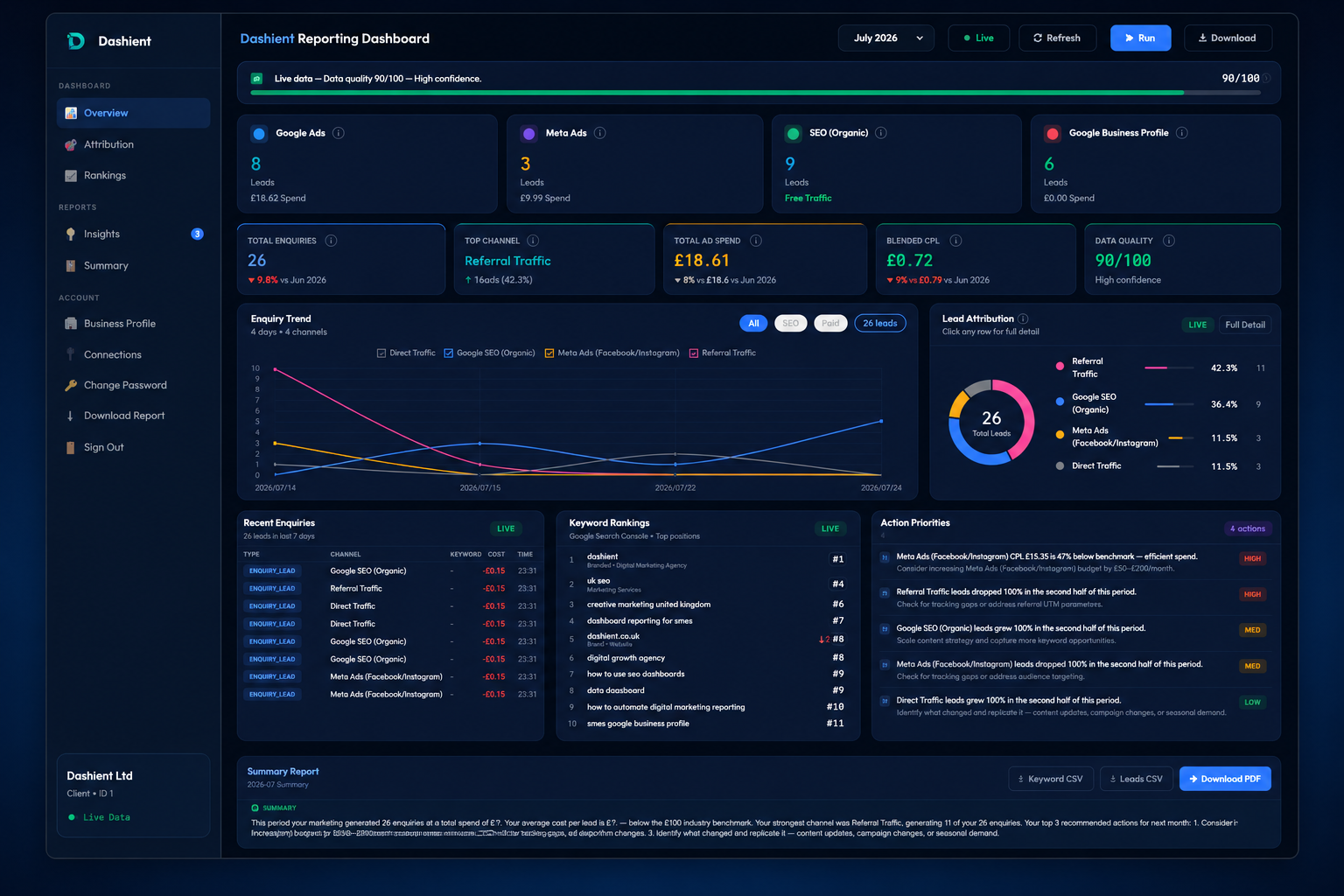
The Dashient Reporting Dashboard (DRD) is Dashient's own take on dashboards as a service: we connect your ads, website, CRM and calls into one live dashboard, so you always know which channel is really driving results — without you or your team having to build or maintain anything. It works hand-in-hand with our lead attribution system, giving you both the reporting view and the attribution behind it in a single, always-on view.
No more guessing. No more last-click bias. No more agency reports that only show the metrics that flatter the agency.
Which One Should You Choose?
If you have an in-house analyst and constantly changing reporting needs, self-service BI gives you the most control. If you only need to monitor one platform, embedded analytics is fine as a supplement. But if your goal is a single, accurate, always-current view across every channel — without hiring for it — dashboards as a service is built for exactly that.
It's also where marketing reporting has been shifting more broadly: away from raw BI software and toward managed, cross-channel reporting delivered as a service, especially for teams that need to see which campaigns actually convert. You can follow our team on LinkedIn for ongoing updates on marketing reporting and attribution in the UK.
Frequently asked questions
Final Thoughts
Self-service BI, embedded analytics and dashboards as a service all promise "one place to see your numbers," but they solve genuinely different problems. Self-service BI gives control to teams that have an analyst to run it. Embedded analytics is a fine supplement when you only ever look at one platform. And dashboards as a service exists for everyone else — the teams that just want an accurate, always-current view across every channel without building or maintaining it themselves.
That's exactly what the Dashient Reporting Dashboard is for: one live view of which channel is really driving your business, so every marketing decision after that is based on evidence, not a guess. Book a free marketing audit and we'll show you what it looks like on your own data.