Why Last-Click Attribution Fails UK Service Businesses
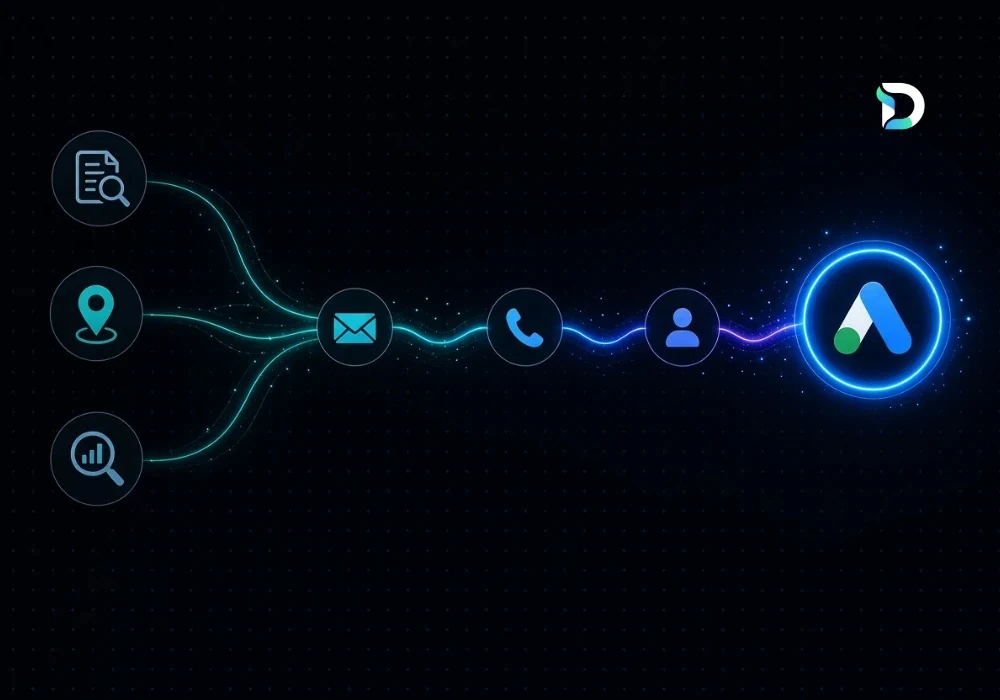
Open most reporting dashboards and you'll find the same story: whichever channel happened to be touched last gets the credit for the sale. A branded Google Ad, a Maps listing, a retargeting ad — whatever the customer clicked right before converting wins the entire line item. Everything that happened before that click is treated as if it never occurred.
That's last-click attribution, and it's the default setting in most tools for a simple reason: it's easy to measure. Easy doesn't mean accurate, though — and for a UK service business running SEO alongside paid ads and a Google Business Profile, the gap between the two can quietly cost real money.
What Last-Click Attribution Actually Does
In last-click attribution, 100% of the credit for a conversion goes to the last qualifying touchpoint before it. If a customer's journey runs from an SEO article, through a paid ad, to a contact form, 100% of the credit goes to the paid ad.
The SEO article gets nothing — even though it might be the reason the customer knew who you were in the first place. It's worth being precise here: the model isn't giving a wrong answer, it's answering a narrow question. The problem arises when that narrow answer is treated as the answer to every question.
Why This Becomes a Problem for Service Businesses Specifically
A software subscription might be bought in one sitting. A roof repair, a commercial cleaning contract or a legal consultation rarely is. Service purchases in the UK typically involve comparison, a bit of trust-building, and more than one visit to your website before anyone picks up the phone.
That longer runway is exactly where last-click attribution struggles. The channels that do the early, unglamorous work of getting a business shortlisted — organic content, a well-optimised Google Business Profile, a helpful blog post found weeks earlier — tend to sit furthest from the final click. On paper, they contribute nothing. In reality, they may be why the enquiry happened at all.
A Worked Example: Commercial Roofing
Picture a commercial roofing company serving Greater Manchester. A facilities manager searches "flat roof maintenance guide" and lands on a blog post. Two weeks later, they search the company by name, click a Google Ad, visit the services page, and call the number provided.
Last-click attribution measures one thing: the conversion, credited entirely to the Google Ad. That's an accurate account of the last interaction — but it ignores the blog post that put the company on the radar two weeks earlier. The point isn't that the blog post "forced" the sale; it's that both interactions were part of a journey that single-click models can't capture.
Lead Generation Isn't the Same as Lead Conversion
It helps to separate the two jobs marketing does. One creates awareness and brings people to you — lead generation in the broadest sense. The other captures the moment someone is ready to act — conversion. Last-click attribution sees only the second and quietly ignores the first.
A dashboard that relies only on last-click will consistently underfund the channels doing that early generation work, simply because they rarely show up in this kind of report.
Last-Click Attribution Inside Google Ads
Within Google Ads specifically, the last-click model gives full conversion credit to the last-clicked ad and its associated keyword. Google Ads also offers data-driven attribution, which distributes credit across multiple ad interactions in a conversion path using account-level conversion data, rather than assigning it all to one click. First-click, linear, time-decay and position-based models are no longer available as attribution settings in Google Ads — so the practical choice today sits between last-click and data-driven. (If you want the full picture of the older models and where each fits, see our breakdown of marketing attribution models.)
Last-Click vs Data-Driven Attribution
| Factor | Last-click | Data-driven |
|---|---|---|
| Credit given to | The final interaction only | Multiple interactions, weighted by data |
| Earlier touchpoints | Not credited | Can be partially credited |
| Setup complexity | Minimal | Requires sufficient conversion data |
| Best suited to | Short, simple journeys | Longer, multi-touch journeys |
| Risk | Undervalues awareness channels | Needs enough volume to be reliable |
What to Track Beyond the Final Click
Moving past last-click doesn't require an enterprise analytics team. It requires tracking a slightly wider set of things, consistently:
- Lead source — organic, paid search, paid social, local, referral.
- Lead action — form submission, phone call, booking request.
- Lead quality — enquiry, qualified lead, sales opportunity, customer.
- Business outcome — revenue and cost per qualified lead, not just cost per click.
Where a Dashboard Changes the Conversation
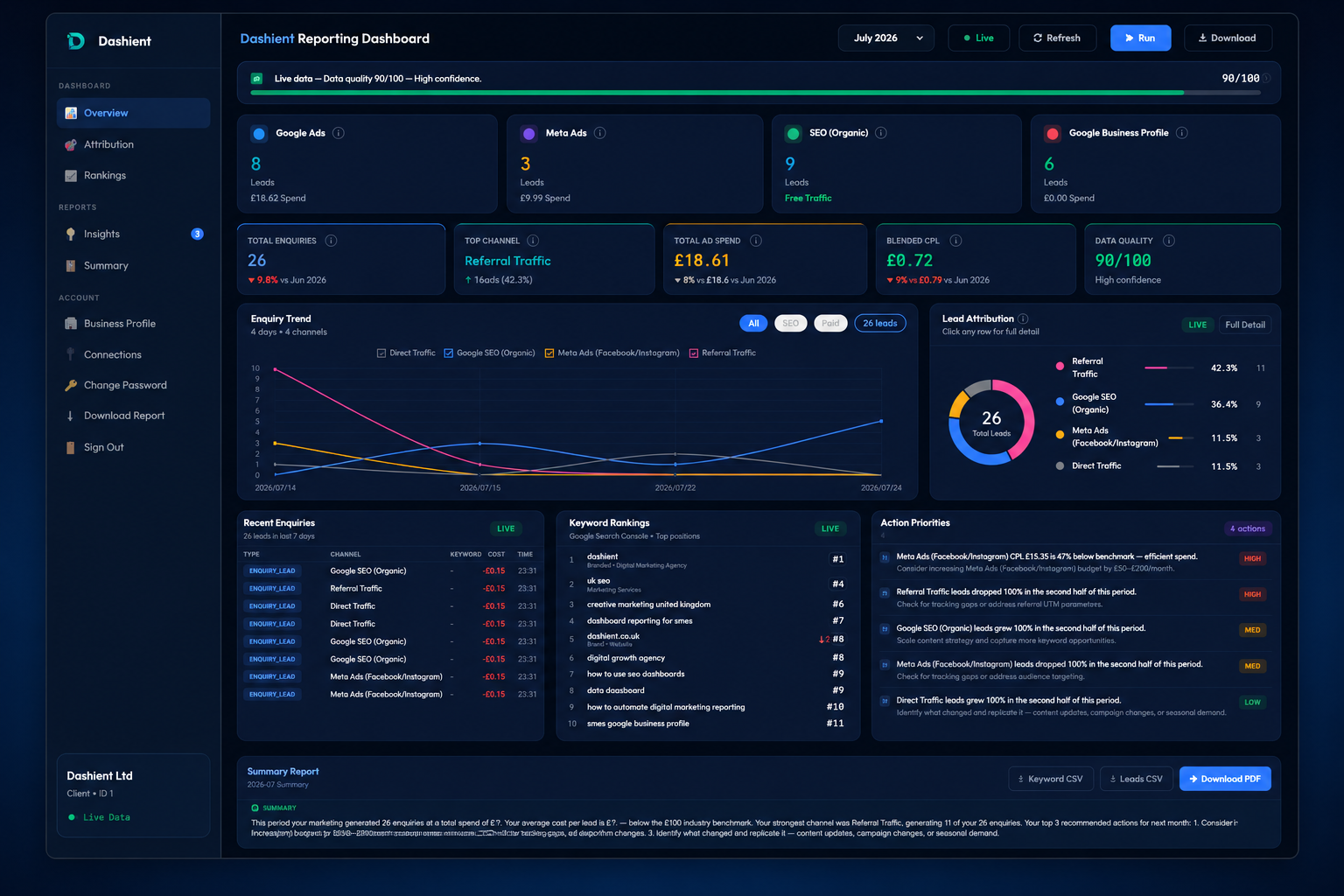
This is precisely the gap the Dashient Reporting Dashboard (DRD) is built to close for UK service businesses. Rather than pulling last-click numbers from Google Ads, a separate GA4 report and a Google Business Profile export — and hoping they tell a consistent story — the DRD connects Google Ads, Meta Ads, GA4, Search Console and Google Business Profile into one view.
Enquiries — forms, click-to-call taps and direction requests — are matched back to the channels that contributed, using multi-touch attribution, so an SEO article that started a journey and a Google Ad that finished it can both be seen, rather than one quietly disappearing from the report. The dashboard refreshes daily, calculates blended cost per enquiry across channels, and typically takes a couple of hours to set up across two short calls. You can see exactly what's included on the how it works page.
When Last-Click Is Still a Reasonable Choice
None of this makes last-click attribution useless, and it would be a mistake to present it that way. It remains a sensible option when the buying journey genuinely is short, when you need quick, simple campaign reporting, or when your tracking infrastructure isn't mature enough yet to support a multi-touch view. Last-click is a limited lens — not a broken one.
Moving Beyond Last-Click, Step by Step
- Define what actually counts as a conversion event.
- Track every lead source consistently, including offline and phone.
- Capture forms and calls as separate, distinct actions.
- Use consistent UTM parameters across every campaign.
- Connect marketing data to your CRM so leads can be followed through.
- Separate raw leads from qualified leads in every report.
- Track customers and revenue, not just enquiries.
- Compare last-click and data-driven views side by side before trusting either one fully.
Common Mistakes Worth Avoiding
- Reporting only on last-click conversions and stopping there.
- Ignoring the organic and local discovery stages entirely.
- Leaving phone enquiries untracked and effectively invisible.
- Never connecting CRM outcomes back to marketing data.
- Treating every lead as equally valuable regardless of source.
- Reading attribution data as proof of causation rather than a model with limits.
Frequently asked questions
Final Thoughts
Last-click attribution isn't dishonest — it's just incomplete, and incomplete data makes for confident-sounding decisions that are sometimes wrong. For a UK service business spending across SEO, paid ads and local search, the fix isn't to distrust every report. It's to widen the lens enough to see the channels doing quiet, early work that a single click can never capture.
If you'd like a clearer view of what's actually driving your enquiries, Book Your Free Growth Audit and we'll walk through your current setup together. You can also follow Dashient on Facebook and LinkedIn.