Entity SEO for Small Businesses: Building Clear Brand Signals
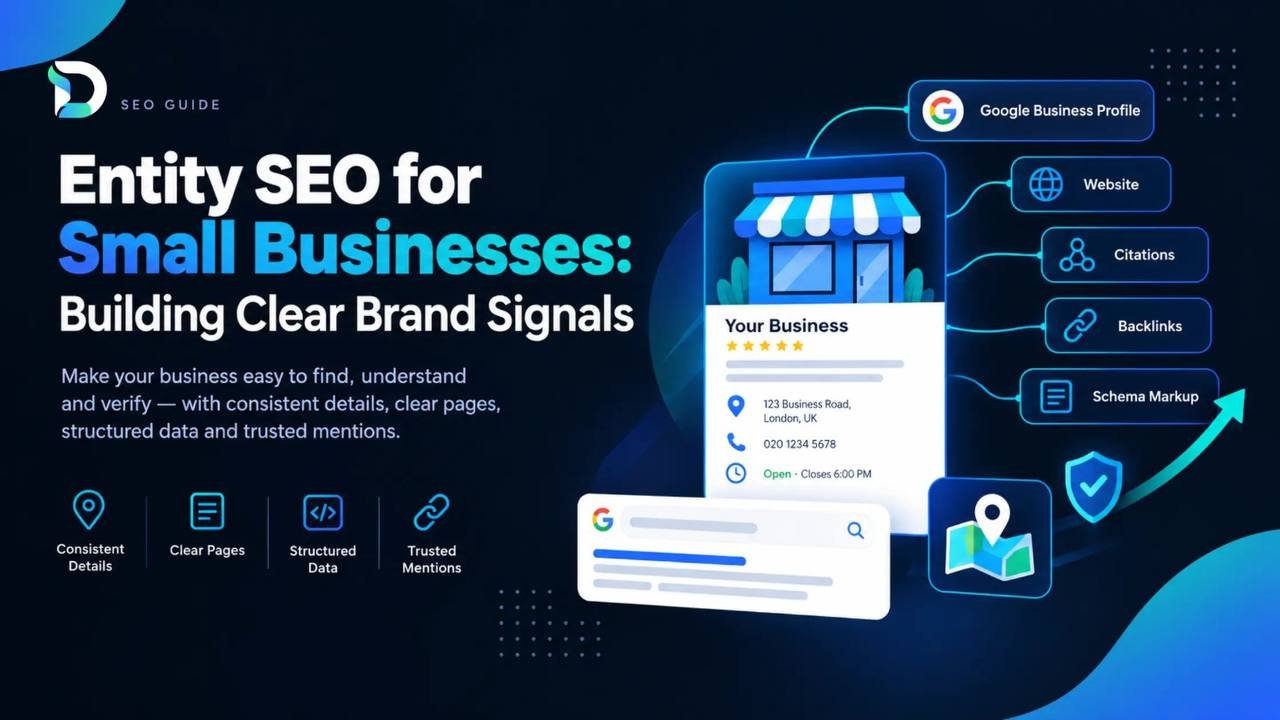
Entity SEO for small businesses means making your business easy for search engines and AI tools to identify, understand and verify. You do it by keeping your name, services and location consistent everywhere, then backing them up with clear pages, structured data and trusted mentions. It does not guarantee rankings, a Knowledge Panel or AI citations.
What Is Entity SEO?
An entity is a distinct thing, such as a business, a person or a place. A keyword is just a phrase people type, and a webpage is just a document. Entity SEO helps search engines connect your business name with your website, services, location and other public information.
Why Clear Brand Signals Matter
If your details differ from place to place, search engines may struggle to tell who you are and what you do. Clear, consistent signals make that easier. They may help with relevance and trust, but they are no shortcut to the top.
7 Ways to Strengthen Your Business Entity Signals
- Keep core details consistent. Use the same name, address and phone number everywhere.
- Build clear About and service pages. Say who you are, what you offer and where.
- Keep Google Business Profile accurate (where eligible), with the right categories and hours.
- Add relevant structured data that matches what visitors can see.
- Earn genuine mentions and citations. A few relevant ones beat many poor ones.
- Link related pages together with descriptive internal links.
- Maintain accurate profiles on platforms your customers actually use.
Here is how weak and strong signals compare. The examples are illustrative.
| Signal | Weak example | Stronger approach | How to verify |
|---|---|---|---|
| Business identity | Three name variations | One name, everywhere | Compare your site, profiles and listings |
| Services | "We do everything" | One clear page per service | Read each page as a stranger would |
| Local information | Old address on some listings | Same address and phone number everywhere | Check Google Business Profile against your site |
| Structured data | Markup that does not match the page | Valid schema that mirrors visible content | Run a structured-data validator |
| External references | Spammy directories | A few relevant, genuine mentions | Review where your name appears |
How to Use Schema Markup for Entity SEO
Use Organization schema for a general business and LocalBusiness schema for a business with a physical location or service area. The sameAs property can point to your genuine official profiles. Keep markup aligned with visible content, and never add fake reviews or invented ratings. Valid markup does not guarantee a rich result or Knowledge Panel.
How to Measure Entity SEO Progress
- Branded impressions and clicks in Search Console.
- Google Business Profile interactions, where available.
- Qualified enquiries and conversions.
- Regular checks of structured data and listing consistency.
No single metric proves Google recognises your entity. Set a baseline and compare over time.
Common Entity SEO Mistakes
The most common are outdated details, thin About pages, schema that contradicts the page, low-quality directory submissions and duplicate profiles. The biggest is expecting guaranteed results.
A Practical 30-Day Action Plan
- Week 1: Audit your name, contact details, services and About page.
- Week 2: Review your Google Business Profile and other listings.
- Week 3: Add and validate Organization or LocalBusiness schema.
- Week 4: Improve internal links, review mentions and set your baseline.
Where Dashient Fits In
Clear signals help people find you. The next question is whether those visitors turn into enquiries. The Dashient Reporting Dashboard is a lead attribution and marketing reporting tool for UK service businesses. It connects Google Ads, Meta Ads, GA4, Search Console and Google Business Profile, and splits enquiries by source and type: forms, click-to-call taps and direction requests. Genuine-lead classification and spam filtering keep the data clean. It measures results; it does not build your entity signals for you.
Setup usually takes 1–3 hours and the team does it for you. See how it works. Every plan has a 30-day free trial with no card required.
| Plan | Price | Key features |
|---|---|---|
| Starter | £49/month | 1 business, all 5 sources, genuine-lead classification, monthly PDF, leads CSV |
| Professional | £99/month | Adds U-shaped attribution, weekly reports, lead manager, up to 3 businesses |
| Agency | £199/month | Adds up to 10 client dashboards and priority support |
All prices exclude VAT. See the dashboard plans page. Need help with the signals themselves? Our local SEO and SEO services can help, and our guides to lead tracking software UK and lead attribution show how to track the results.
Also From Dashient: ScopeCheck
Dashient also runs ScopeCheck, a tool for UK homeowners comparing trade quotes. You add 2–5 quotes for the same job, and it shows what each includes, what is missing and what to ask. There is a free preview with no sign-up.
Frequently Asked Questions
What is entity SEO in simple terms?
It is making your business easy for search engines to identify and verify. You keep your details consistent and support them with clear pages, structured data and trusted mentions.
Does entity SEO help small businesses?
It can help search engines understand your business, services and location. It is no guarantee of better rankings, so treat it as a foundation, not a shortcut.
Is schema markup necessary for entity SEO?
No, but it can help. Clear pages, consistent details and a good business profile matter just as much. Schema must always match what visitors see.
Does entity SEO help with AI search visibility?
Clear, consistent information may make your business easier for AI tools to interpret. No one can guarantee AI mentions or citations.
Final Thoughts
Entity SEO is about being clear, consistent and easy to verify. Start with your basics, add structured data carefully and measure what matters: real enquiries. Results take time, so be patient.
Ready to see which channels bring real enquiries? Start your free trial for 30 days, no card required. Already a user? Sign in. Want expert help with SEO and ads? Book Your Free Growth Audit today.